
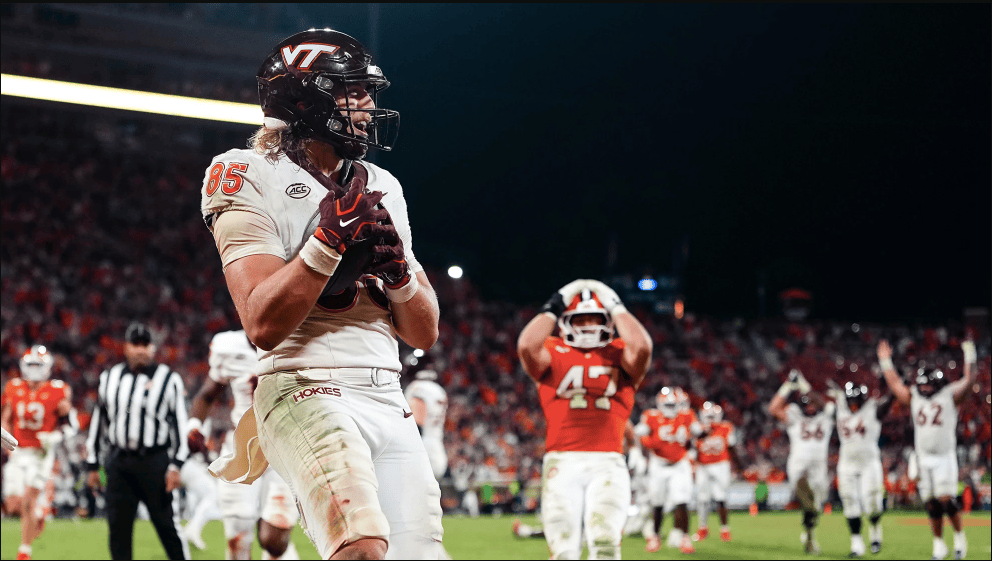
Eight games into the James Franklin era, Virginia Tech is 6-2, bowl eligible, and coming off consecutive victories over Georgia Tech and Clemson. I’ll take it.
If you had told me before the season that Virginia Tech would enter its bye week with six wins, including a road victory at Clemson, I would have been pretty happy. Especially considering where this program was just a year ago.
But here’s the frustrating part. Virginia Tech is probably three or four plays away from being undefeated.
The Hokies lost to Pittsburgh 35-33 and California 25-20 in games they had opportunities to win. A couple of made field goals, a defensive stop, or better execution in the fourth quarter, and we’re potentially talking about an 8-0 football team.
Instead, we’re talking about a 6-2 team that has already exceeded many reasonable expectations but still hasn’t quite figured out how to consistently get out of its own way.
And that’s what makes the final four games so interesting. Virginia Tech has already accomplished the minimum expectation for Franklin’s first season. The Hokies are going bowling. They’ve demonstrated they can win on the road. They’ve beaten two recognizable ACC opponents in consecutive weeks.
Now the question becomes whether this team is simply better than what we’ve watched over the past several years or whether it’s actually capable of competing with the best teams in the conference. Those are two very different things.
1. James Franklin Has Already Changed the Expectations
Let’s start with the obvious. Virginia Tech looks like a competently coached football team again. That shouldn’t be a particularly high bar for a program with Virginia Tech’s resources and history, but here we are.
Franklin inherited a program that had spent the better part of a decade searching for an identity. Justin Fuente couldn’t sustain the early momentum. Brent Pry couldn’t turn recruiting optimism into consistent victories.
And now Franklin has Virginia Tech sitting at 6-2 with four games remaining. The most encouraging development isn’t necessarily the record. It’s that Virginia Tech has generally looked like the more prepared team when it takes the field.
There are actual offensive concepts. There’s a recognizable identity. The Hokies have enough talent to exploit opponents’ weaknesses instead of simply hoping the other team makes more mistakes. That’s progress.
But I’m not ready to declare the rebuild complete. Franklin’s teams have struggled coming out of halftime, and the two losses exposed some pretty significant problems with game management and execution.
The standard at Virginia Tech shouldn’t be simply reaching a bowl game. It should be competing for ACC championships.
Franklin wasn’t hired to turn a four-win team into a perennial seven-win team. He was hired to make Virginia Tech nationally relevant again. Six wins in eight games is an excellent start. It’s not the destination.
2. The Offense Is Better Than I Expected
One of my biggest concerns entering the season was how quickly Virginia Tech could develop an offensive identity with so many new pieces.
Eight games later, I’m pretty encouraged. Ethan Grunkemeyer has provided stability at quarterback, and the combination of his passing ability and the Hokies’ rushing attack has made this offense considerably more difficult to defend.
I also think Jeffrey Overton has been one of the more important pieces of the offensive turnaround. When Virginia Tech can establish the run, the entire offense opens up. Grunkemeyer doesn’t have to carry the team on every possession, the offensive line can play more aggressively, and opposing defenses have to respect multiple ways of moving the football.
The offense isn’t perfect. There are still stretches when the play-calling becomes predictable. The California game was particularly frustrating because Virginia Tech never seemed to establish a consistent rhythm.
And the Hokies have a tendency to make things unnecessarily difficult in the red zone. But compare this offense to what we’ve watched in Blacksburg over the past several seasons. It’s not particularly close.
The biggest question moving forward is whether the offense can maintain that production against better competition.
SMU and Miami are going to provide significantly more difficult tests than some of the teams Virginia Tech has already faced.
If the Hokies want to win either of those games, Grunkemeyer and the offense are going to have to play well for four quarters. Not two. Not three.
Four.
3. The Defense Still Makes Me Nervous
Virginia Tech’s defense has been one of the more frustrating parts of this season. There are stretches when the Hokies look perfectly capable of shutting down an opponent.
Then there are stretches when opposing quarterbacks seemingly complete every pass they attempt.
The secondary has been a particular concern. Pittsburgh scored 35 points. California scored 25. Even in victories, Virginia Tech has occasionally struggled to prevent explosive passing plays.
The Clemson game was encouraging because the Hokies held the Tigers to 16 points on the road. But let’s not pretend Clemson’s offense is particularly good this season.
The Tigers have struggled to move the football consistently, especially through the air. Holding them to 16 points is a positive development, but it’s not necessarily proof that Virginia Tech has solved its defensive problems.
SMU and Miami will be much better measuring sticks. The biggest issue for me remains situational defense.
Can Virginia Tech get off the field on third down? Can it prevent explosive plays? Can it protect a lead in the fourth quarter?
Those are the situations that separate good defenses from average ones.
Virginia Tech doesn’t need to have the best defense in the ACC to win nine games. But it can’t continue giving opposing offenses opportunities to extend drives because of missed assignments, penalties, or poor tackling. The Clemson victory was a step in the right direction.
4. Special Teams Have Been Anything But Special
I never thought I’d be writing about Virginia Tech’s special teams being one of the team’s biggest weaknesses.
But here we are.
John Love’s struggles have been particularly frustrating. The Hokies have missed opportunities to put points on the board, and those misses played a significant role in the losses to Pittsburgh and California. To Love’s credit, he responded with a couple of important field goals against GT and Clemson. Hopefully that’s the beginning of a turnaround.
Que’Sean Brown has provided some excitement in the return game, and I still think he’s capable of breaking a punt return for a touchdown before the season ends. But the overall special teams performance hasn’t been good enough.
Punting has been inconsistent. Field position has occasionally been a problem. And the kicking game has already cost Virginia Tech opportunities to win close games.
For a program built around the legacy of Beamerball, that’s pretty disappointing. Franklin doesn’t need to recreate Frank Beamer’s special teams philosophy overnight. But Virginia Tech shouldn’t be losing games because it can’t consistently execute basic special teams responsibilities.
That’s something that needs to improve over the bye week.
5. The Clemson Win Was Important, Even If Clemson Isn’t Clemson Anymore
I don’t particularly care that Clemson is having a down year. Winning in Death Valley is still a big deal.
Virginia Tech hadn’t played at Clemson since 2012, and the Hokies entered one of college football’s more intimidating environments and walked away with a 20-16 victory. That’s something worth celebrating.
For years, Virginia Tech has struggled to win games against recognizable conference opponents, particularly on the road. The Clemson victory was another sign that Franklin is changing that.
But context matters.
This isn’t the Clemson program that was routinely competing for national championships under Dabo Swinney. The Tigers have significant offensive limitations, and Virginia Tech still needed to grind out a four-point victory. I’m encouraged that the Hokies found a way to finish the game. I’m less encouraged that they couldn’t put away an opponent that was struggling to move the football.
Both things can be true. Virginia Tech deserves credit for winning. And Virginia Tech still has plenty of work to do.
6. The ACC Is Still There for the Taking — Sort Of
Miami looks like the class of the conference. The Hurricanes are 7-0, ranked No. 1 nationally, and have been dismantling opponents.
Wake Forest has also emerged as a legitimate contender, while SMU remains one of the stronger teams in the conference.
Virginia Tech, meanwhile, is sitting at 3-2 in ACC play. The losses to Pittsburgh and California are particularly damaging because both teams own the head-to-head tiebreaker over the Hokies.
That makes Virginia Tech’s path to Charlotte considerably more complicated. But the schedule also provides an opportunity. Virginia Tech still plays SMU and Miami. Win those games, and suddenly the conference standings become a lot more interesting. Of course, that’s considerably easier said than done.
I don’t think Virginia Tech is an ACC championship-caliber team right now. But I also don’t think the Hokies are as far away as I expected them to be in October. That’s encouraging.
And for the first time in a while, it’s nice to enter November with something more meaningful to discuss than which bowl game Virginia Tech might qualify for.
7. The Remaining Schedule Is Tough
VIRGINIA TECH REMAINING 2026 SCHEDULE
My Outlook
| Nov. 6 | at SMU | Toss-up / Lean Loss |
| Nov. 14 | Stanford | Win |
| Nov. 21 | at Miami | Loss |
| Nov. 28 | Virginia | Win |
The Hokies have two difficult road games, one very winnable home game, and a rivalry game that should never be taken for granted.
At SMU
This might be the most important game remaining on the schedule. The Mustangs have established themselves as one of the ACC’s better programs, and winning in Dallas on a Friday night won’t be easy. But I think this is a winnable game.
Virginia Tech has demonstrated enough offensive ability to compete, and the Clemson victory should provide some confidence heading into another difficult road environment. The question is whether the defense can hold up.
Stanford
Virginia Tech should win this game.Stanford has struggled this season, and the Hokies will be back in Lane Stadium. There really isn’t a good excuse for losing this one.
At Miami
Let’s be realistic. Miami is one of the best teams in college football. The Hurricanes have significantly more talent across the roster, an explosive offense, and legitimate national championship aspirations. Virginia Tech will need to play its best game of the season just to have a chance. I’m not predicting a win. But I am interested in seeing how competitive the Hokies can be.
Virginia
Beat UVA. Franklin needs to establish early that losing to Virginia isn’t something Virginia Tech is going to accept.
8. What Would Make This Season a Success?
Before the season, I predicted Virginia Tech would finish 8-4. That felt slightly optimistic considering the amount of turnover and the difficulty of the schedule. Eight games later, I still think 8-4 is the most likely outcome. But my expectations have changed.
How I’d grade the possible finishes
6-6
Disappointing. Losing four straight would erase much of the momentum.
7-5
Acceptable on paper, but a frustrating finish.
8-4
A successful first season and meaningful progress.
9-3
An excellent first season, ahead of schedule.
10-2
One of the most impressive turnarounds in college football.
Here’s where things get interesting.
If Virginia Tech beats Stanford and Virginia, the Hokies finish 8-4. That’s a successful season. But after watching this team through eight games, I think nine wins are a realistic possibility. Beat SMU, take care of Stanford, and beat Virginia.
That’s 9-3.
And a nine-win regular season in Franklin’s first year would be an outstanding accomplishment. It would also provide Virginia Tech with something it has desperately needed for years.
Momentum.
Not hypothetical momentum based on recruiting rankings or offseason optimism. Actual momentum based on winning football games.
9. The Bye Week Couldn’t Have Come at a Better Time
Virginia Tech has played eight consecutive games.The Hokies have experienced a four-game winning streak, two frustrating losses, and two important bounce-back victories.
That’s a lot of football.
The bye week gives Franklin and his staff an opportunity to address some of the problems that have persisted throughout the season.
The biggest priorities should be pretty obvious.
- Fix the third quarter. Virginia Tech has repeatedly struggled coming out of halftime. Whatever adjustments the coaching staff is making aren’t consistently working.
- Improve the secondary. SMU and Miami will expose the same weaknesses Pittsburgh and California exploited if the Hokies don’t make changes.
- Get the kicking game right. Close games are going to come down to field goals. Virginia Tech needs to trust its kicker.
- Eliminate unnecessary penalties. The Hokies have improved in this area, but there are still too many avoidable mistakes.
- Get healthy. The final month includes two difficult road trips. Virginia Tech needs its best players available.
There’s also something to be said for simply giving the players an opportunity to recover mentally. The Clemson victory was emotional. The Georgia Tech game was important. The losses to Pittsburgh and California were frustrating.
Now the Hokies get an opportunity to reset before the final month of the regular season.
They need to take advantage of it.
10. Sticking With My Prediction: 8-4
I’m sticking with my preseason predictions:
| at SMU | Loss |
| Stanford | Win |
| at Miami | Loss |
| Virginia | Win |
Final Regular Season Record: 8-4
Final Thoughts
Virginia Tech is in a much better position than it was a year ago. That much is undeniable. The Hokies have a legitimate head coach, an offense capable of putting points on the board, and a roster that has already demonstrated it can win difficult road games.
But there’s still a gap between where Virginia Tech is and where it wants to be.
The defense needs to improve. Special teams need to become an advantage instead of a liability. And Franklin needs to figure out why his team continues to struggle coming out of halftime.
Those aren’t insignificant problems. They’re also problems that can be fixed. What I find most encouraging is that Virginia Tech is no longer relying entirely on hope.
We’ve actually seen this team play good football. We’ve watched the Hokies win games they might have lost in previous seasons. And we’ve watched them go into Clemson and leave with a victory.
That’s progress.
The next four games will tell us just how much progress Franklin has made. An 8-4 season would be a successful beginning. A 9-3 season would be an excellent one. Anything better, and we might need to start having some very different conversations about the future of Virginia Tech football.
For now, I’m enjoying the fact that Virginia Tech is bowl eligible before Halloween and still has meaningful football left to play. It’s been a while since that felt normal. Let’s go beat SMU.
Go Hokies.

