
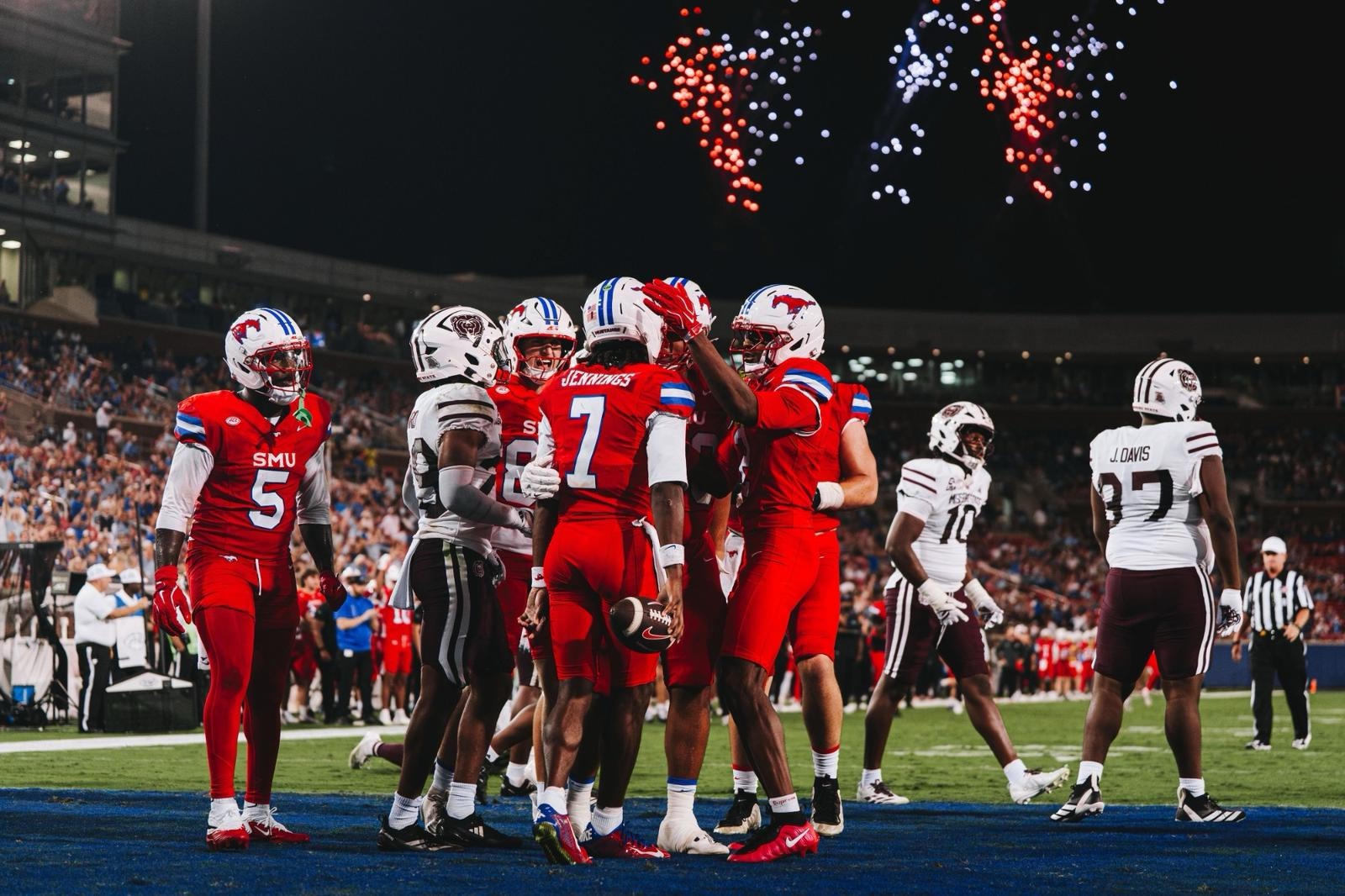
The Big Picture
What a difference two weeks can make.
The last time we saw Virginia Tech, the Hokies were celebrating a 20-16 victory over Clemson in Death Valley. It wasn’t always pretty, the offense struggled to establish a running game, and there were plenty of moments where it looked like another frustrating close loss was coming. But when it mattered most, James Franklin’s team found a way to win. That’s something we haven’t been able to say nearly enough about Virginia Tech football over the last decade.
Now the Hokies are 6-2, bowl eligible before November, and still playing meaningful football in the ACC race. Considering where this program has been, that’s a pretty good place to be eight games into the Franklin era. But nobody should be satisfied yet.
Virginia Tech heads to Dallas on Friday night for what might be its toughest remaining road test. SMU is also 6-2, has one of the most explosive offenses in the ACC, and is looking to rebound from a disappointing 30-27 loss at Syracuse.
The Mustangs are nearly a touchdown favorite, and for good reason. They’re extremely dangerous offensively, they’ve been excellent at home, and they present some serious matchup problems for Virginia Tech’s secondary.
But the Hokies have a few things working in their favor, too. They’re coming off a bye week, they’re getting healthier along the offensive line, and their defense has developed into one of the most disruptive units in the conference. There’s also the matter of momentum. Virginia Tech has won two straight, including arguably its biggest road victory in years. SMU just watched Syracuse score the winning touchdown with 17 seconds remaining.
Both teams are still alive in the ACC race, but a third conference loss would make the road to Charlotte significantly more difficult. Friday night is an opportunity for Virginia Tech to prove that the Clemson victory wasn’t just a great moment. It was a sign of things to come.
A Look at SMU
Rhett Lashlee has done a tremendous job turning SMU into a legitimate ACC contender.
When the Mustangs joined the conference in 2024, plenty of people questioned whether a former American Athletic Conference program could immediately compete with the league’s established powers.
Those questions disappeared pretty quickly. SMU reached the College Football Playoff in its first ACC season, and Lashlee has continued building a program capable of competing near the top of the conference.
This year’s team enters Friday at 6-2 overall and 4-2 in ACC play. The Mustangs had won four consecutive games before their loss to Syracuse, including an impressive 59-20 demolition of California. Yes, the same California team that beat Virginia Tech 25-20. College football’s transitive property is undefeated until it isn’t.
The Mustangs have a dynamic offense led by quarterback Kevin Jennings, an experienced offensive line, and enough skill-position talent to create problems for just about anybody. Defensively, they’re solid across the board and particularly effective at getting opponents off the field on third down. However, SMU isn’t without weaknesses. The Mustangs have struggled with turnovers, penalties, and finishing defensive possessions in the red zone.
Those weaknesses give Virginia Tech a legitimate opportunity to pull off the upset.
By the Numbers
Season averages through games played October 31, 2026.
| Statistic | Virginia Tech | SMU |
|---|---|---|
| Points per game | 35.0 | 35.3 |
| Total offense | 424.1 | 467.3 |
| Passing offense | 284.4 | 320.4 |
| Rushing offense | 139.8 | 146.9 |
| Points allowed | 20.5 | 22.3 |
| Total defense | 311.4 | 307.6 |
| Passing yards allowed | 218.0 | 181.8 |
| Rushing yards allowed | 93.4 | 125.9 |
The numbers suggest two pretty evenly matched teams.
SMU has the advantage offensively, particularly through the air, while Virginia Tech has been slightly better at keeping opponents off the scoreboard and significantly better against the run.
The biggest statistical mismatch is SMU’s passing attack against Virginia Tech’s pass defense. The biggest opportunity for the Hokies is their defensive front against an SMU offense that can become vulnerable when forced into obvious passing situations. That battle could decide the game.
When Virginia Tech Has the Ball
The good news for Virginia Tech is that Ethan Grunkemeyer has been significantly better than most people probably expected entering the season. Through eight games, the Penn State transfer has completed 71.4% of his passes for 2,140 yards, 17 touchdowns, and just two interceptions. He’s also added five rushing touchdowns. Those are impressive numbers for a quarterback in his first season running a new offense.
Grunkemeyer hasn’t been perfect, but he’s been efficient, he’s protected the football, and he’s shown an ability to deliver in important situations. Against Clemson, he wasn’t particularly spectacular statistically, throwing for just 156 yards. But he made the throws he needed to make, including the fourth-down touchdown to Luke Reynolds that ultimately won the game.
That’s the kind of quarterback play Virginia Tech has been missing. The problem is that the Hokies haven’t been able to consistently complement their passing game with an effective rushing attack. Jeffrey Overton Jr. has rushed for 639 yards this season, but Virginia Tech is averaging just 139.8 rushing yards per game, ranking 95th nationally. Against Clemson, Overton managed only 26 yards on 10 carries. That’s not going to get it done against SMU.
The Mustangs have one of the better third-down defenses in the country, allowing opponents to convert just 27% of the time. They also have 22 sacks and an experienced defensive front that can create problems with pressure packages and disguised blitzes.
Fortunately, Virginia Tech should be getting some help. James Franklin indicated Monday that offensive linemen Montavious Cunningham and Brody Meadows are expected back following the bye week. Justin Terry, however, remains unavailable. Those returns couldn’t come at a better time.
If Virginia Tech can establish even a moderately effective rushing attack, it should open opportunities for Grunkemeyer and his receivers. Que’Sean Brown leads the team with 685 receiving yards, while tight end Luke Reynolds has become one of the most dependable targets in the ACC, recording 50 catches for 493 yards and six touchdowns. Both will need to have productive nights.
SMU is allowing just 181.8 passing yards per game, so this won’t be an easy matchup. But the Mustangs have also allowed opponents to score on 90% of their red-zone trips. Virginia Tech needs to take advantage of those opportunities. Field goals aren’t going to beat SMU.
When SMU Has the Ball
This is where things get interesting. Kevin Jennings might be the best quarterback Virginia Tech has faced this season.
The fifth-year SMU quarterback has thrown for more than 2,400 yards and 21 touchdowns while completing nearly 74% of his passes. He’s mobile, experienced, accurate, and capable of turning broken plays into explosive gains. In other words, he’s exactly the kind of quarterback who can give Virginia Tech’s defense problems.
Jennings is coming off a 351-yard performance against Syracuse in which he completed 29 of 36 passes. Despite those numbers, SMU still lost 30-27. That’s encouraging for Virginia Tech. The Mustangs also have a talented running back in Kendrick Raphael, who has rushed for 697 yards and nine touchdowns, while receivers Yamir Knight and Yannick Smith provide dangerous options downfield.
SMU averages 467.3 yards and 35.3 points per game.
This offense is legitimate. But so is Virginia Tech’s defensive front. The Hokies lead the ACC with 27 sacks and 11 forced fumbles. They’re allowing just 93.4 rushing yards per game, good for 12th nationally. That’s a pretty impressive turnaround for a unit that struggled with consistency earlier in the season.
Kemari Copeland, Mylachi Williams, and Aycen Stevens have helped establish a physical identity up front, while Jaquez White has emerged as a difference-maker in the secondary. White was outstanding against Clemson, finishing with 11 tackles and a critical late sack.
The challenge this week will be substantially different. Clemson struggled to consistently threaten Virginia Tech through the air. SMU won’t have that problem. The Mustangs average more than 320 passing yards per game, and Virginia Tech’s secondary has been vulnerable to explosive plays.
The Hokies can’t expect to sit back in coverage and hope Jennings makes mistakes. They need to pressure him. Syracuse sacked Jennings four times last weekend after SMU had surrendered only eight sacks through its first seven games. If Virginia Tech can create similar pressure, the Hokies have a chance to disrupt the Mustangs’ offensive rhythm.
If Jennings has time to sit in the pocket, it could be a long night.
Three Keys to the Game
1. Get Pressure on Kevin Jennings
This is the most important matchup of the night. Virginia Tech’s defensive line has been one of the team’s biggest strengths, and the Hokies need another big performance. Jennings is too talented to allow him to operate comfortably.
The good news is that Virginia Tech doesn’t necessarily need to blitz to generate pressure. The Hokies have enough talent along the defensive front to create disruption with four rushers. That will be important because sending additional defenders after Jennings could leave an already vulnerable secondary exposed.
The goal should be to force Jennings into quick decisions, limit explosive plays, and make SMU put together long, sustained drives. SMU has also struggled with turnovers this season, entering the game with a minus-five turnover margin. Virginia Tech needs to capitalize on that weakness.
2. Establish Something Resembling a Running Game
I’m not asking Virginia Tech to suddenly become the 1999 Hokies. But 26 rushing yards from your starting running back isn’t going to cut it. The Hokies need to find a way to create manageable second- and third-down situations. SMU’s defense is too good on third down to consistently put Grunkemeyer in obvious passing situations.
The returns of Cunningham and Meadows should help, but Virginia Tech still needs better execution up front. A productive running game would also help keep Jennings and the SMU offense on the sideline. Virginia Tech averages more than 32 minutes of possession per game, compared to SMU’s 29:24.
That’s an advantage worth maintaining.
3. Win the Turnover Battle
This might be the simplest key of them all. SMU has been careless with the football at times this season, while Virginia Tech has generally done a good job protecting it offensively.
Grunkemeyer has thrown just two interceptions in eight games.
Jennings has thrown five.
The Hokies have also forced 11 fumbles, although forcing fumbles and recovering them are two very different things. Virginia Tech needs to turn its defensive disruption into actual takeaways. In a game where both offenses are capable of scoring 30-plus points, one additional possession could be the difference between winning and losing.
Players to Watch
Ethan Grunkemeyer — Virginia Tech QB
The Hokies don’t need Grunkemeyer to throw for 400 yards. They need him to continue making smart decisions, protecting the football, and delivering in critical situations. His ability to handle SMU’s pressure packages will be a major factor.
Kevin Jennings — SMU QB
Jennings is the engine that makes the Mustangs go. He’s accurate, mobile, and dangerous downfield. Virginia Tech’s defense needs to make him uncomfortable early and often.
Luke Reynolds — Virginia Tech TE
Reynolds has become Grunkemeyer’s security blanket, especially in critical situations. His size and physicality should create opportunities against SMU’s defense, particularly in the red zone.
Kendrick Raphael — SMU RB
Raphael has been extremely productive this season, averaging more than five yards per carry. Virginia Tech needs to keep him contained and force SMU to become one-dimensional.
Betting Preview
The oddsmakers have SMU favored by 6.5 points, with an over/under of 55.5.
That seems reasonable.
SMU is undefeated at home this season, while Virginia Tech is coming off its biggest victory of the year and has had nearly two weeks to prepare.
The Mustangs have the more explosive offense, but Virginia Tech has the defensive front capable of making things difficult.
A few betting trends stand out.
Virginia Tech is 5-3 against the spread this season, while SMU is 3-4-1 according to the Associated Press. The Hokies also haven’t lost a game by more than five points.
Meanwhile, SMU’s turnover problems and tendency to commit penalties make the Mustangs difficult to trust as nearly a touchdown favorite.
There’s also a pretty significant rest advantage for Virginia Tech.
The Hokies haven’t played since October 24, while SMU played Syracuse on October 31.
I think that matters, particularly given Virginia Tech’s offensive line injuries.
My betting lean: Virginia Tech +6.5.
I wouldn’t be surprised if SMU wins this game, but I have a hard time believing there’s a full touchdown separating these teams.
As for the total, both offenses average approximately 35 points per game, but both defenses have also been fairly effective.
Virginia Tech’s ability to control possession could keep the scoring lower than expected.
My total lean: Under 55.5.
Neither is a particularly strong play, but I’d be more comfortable taking the points than laying them.
Prediction
This is a fascinating matchup.
Virginia Tech has a chance to take another major step forward in James Franklin’s first season, but the Hokies are going to have to play one of their best games of the year to leave Dallas with a victory.
SMU is extremely dangerous offensively, and Kevin Jennings presents a legitimate challenge for Virginia Tech’s secondary. I expect the Mustangs to have success moving the football, particularly through the air.
But I also think Virginia Tech’s defensive front is capable of creating enough negative plays to keep SMU from completely taking over the game.
Offensively, the Hokies should benefit from the return of two offensive linemen and an extra week of preparation. Grunkemeyer has been remarkably efficient this season, and I trust him to keep Virginia Tech competitive. The question is whether the Hokies can finish drives with touchdowns instead of field goals.
I think this game looks a lot like the Pittsburgh and California losses, with both teams trading punches and the outcome coming down to a handful of critical plays in the fourth quarter. The difference is that Virginia Tech has started finding ways to win those games. We saw it against Clemson. Let’s see if we see it again Friday night.
Prediction: SMU 30, Virginia Tech 27
Final Thoughts
There are still plenty of questions about Virginia Tech. The offensive line remains a work in progress. The running game has been inconsistent. The secondary has struggled with explosive passing plays. And the Hokies still haven’t put together four quarters of consistently good football against a quality opponent. But there’s also no denying the progress this program has made.
Virginia Tech is 6-2, has won two consecutive games, and is coming off its first victory at Clemson since 2007. The Hokies are playing meaningful football in November, and that’s something worth appreciating. A win over SMU would take things to another level.
It would give Virginia Tech seven victories with three regular-season games remaining, another quality road win, and a legitimate argument that the Hokies belong among the better teams in the ACC. More importantly, it would demonstrate that the Clemson victory wasn’t an isolated result. This team is learning how to win. Now it’s time to prove it again. Let’s go get another one. Go Hokies.

