
Saturday, October 17, 2026 • 3:30 PM ET • Lane Stadium, Blacksburg, VA • ACC Network
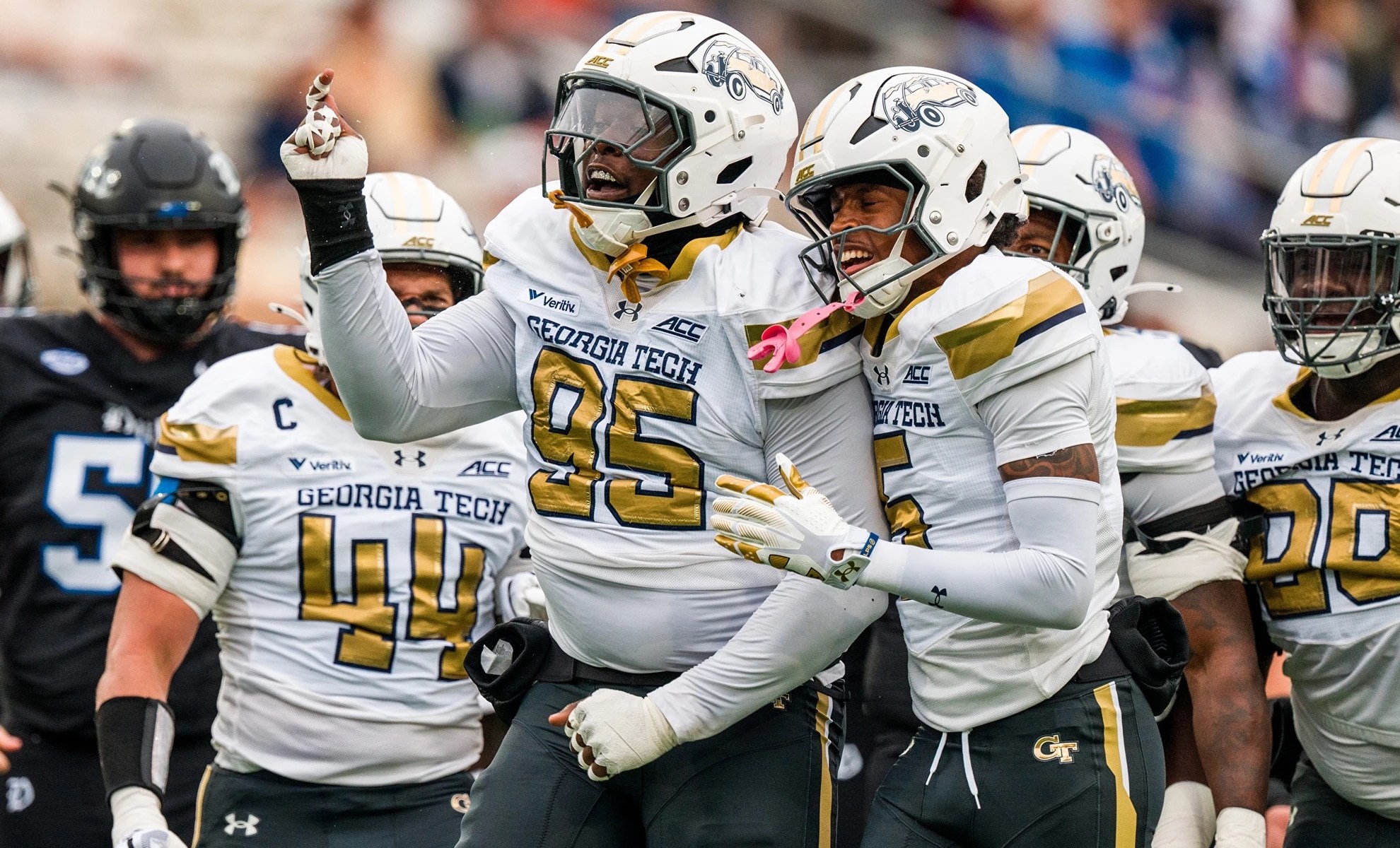
Georgia Tech vs. Virginia Tech
Two weeks ago, Virginia Tech was 4-0, riding the momentum of an undefeated September, and Hokie fans were beginning to entertain the possibility that James Franklin might have this program ahead of schedule.
Two weeks and two heartbreaking losses later, the Hokies are 4-2, sitting at 1-2 in ACC play, and desperately searching for answers.
The 35-33 loss to Pittsburgh was frustrating enough. Virginia Tech had opportunities to win that game and couldn’t finish. But last Saturday’s 25-20 loss at California was arguably worse. The Hokies traveled across the country, struggled to establish any consistency, and somehow managed to take the lead with just over a minute remaining before watching Cal march down the field for the game-winning touchdown.
For the second consecutive week, Virginia Tech found a way to lose a game it had every opportunity to win.
Now comes Georgia Tech.
The Yellow Jackets enter Saturday’s Homecoming matchup with a 2-3 record, but they’re coming off a dramatic 28-25 victory over Duke. Brent Key’s team has struggled through the first half of the season, but there’s enough talent on the roster to make the Hokies uncomfortable.
And if recent history has taught us anything, it’s that Virginia Tech doesn’t need much help making itself uncomfortable.
The good news? The Hokies return to Lane Stadium, where they’ll play in front of their fourth consecutive sellout crowd.
The bad news? Georgia Tech has won four of its last five trips to Blacksburg.
Saturday represents an opportunity to stop the bleeding, regain some confidence, and prevent a promising season from spiraling into another exercise in frustration.
Because with a trip to Clemson looming next weekend, a third consecutive loss would change the entire conversation surrounding James Franklin’s first season.
What Happened to the 4-0 Hokies?
The most frustrating part of Virginia Tech’s two-game losing streak isn’t necessarily that the Hokies have lost. It’s how they’ve lost.
Against Pittsburgh, the Hokies scored 33 points and still couldn’t escape with a victory. Against California, they held a 20-19 lead with 1:15 remaining before surrendering a touchdown with 18 seconds left.
That’s two conference losses by a combined seven points.
And while there’s a temptation to dismiss close losses as bad luck, Virginia Tech has repeatedly made the kinds of mistakes that turn potential victories into defeats.
Penalties. Missed kicks. Defensive breakdowns. Inability to execute in critical moments.
The encouraging part is that this team isn’t getting blown off the field. The concerning part is that it hasn’t demonstrated an ability to consistently close games against competent ACC competition.
The Offense: Grunkemeyer Continues to Produce
For all the frustration surrounding the past two weeks, Virginia Tech’s offense has been one of the more encouraging developments of the James Franklin era.
Quarterback Ethan Grunkemeyer leads the ACC with 1,734 passing yards through six games and has thrown 12 touchdowns against just two interceptions.
The Hokies are averaging 37.7 points per game, the third-highest total in the conference.
Those numbers suggest an offense capable of competing with just about anyone on Virginia Tech’s schedule.
But the California game exposed an important distinction between accumulating statistics and consistently executing.
Virginia Tech scored just 20 points against the Golden Bears, and the offense struggled to maintain rhythm throughout the afternoon.
Grunkemeyer eventually delivered what should have been the decisive score, a one-yard touchdown run that gave the Hokies the lead late in the fourth quarter.
Unfortunately, the defense couldn’t finish the job.
Against Georgia Tech, Virginia Tech should have opportunities to move the football. The Yellow Jackets are allowing nearly 389 yards per game, placing them among the ACC’s weaker defenses.
The challenge will be converting those opportunities into touchdowns rather than settling for field-goal attempts.
Which brings us to…
The Special Teams: A Growing Concern
John Love entered the season as one of Virginia Tech’s most dependable players.
Now the kicking game has become a legitimate concern.
Love missed a potential game-winning field goal against Pittsburgh and followed that performance with two more misses against California.
That’s three consecutive missed field goals in two games decided by a combined seven points.
James Franklin has publicly supported Love while acknowledging that competition at the position remains open, with Will Love and Cole Byrd among the alternatives.
Punter Nathan Totten has also struggled, averaging approximately 41 yards per punt.
Virginia Tech simply cannot continue giving away points and field position in close games.
Special teams are supposed to be an advantage for a well-coached football team. Right now, they’re creating additional obstacles for a program that already has enough of them.
Meet the Yellow Jackets
Georgia Tech entered the season hoping to build on the success Brent Key established over the past several years.
Instead, the Yellow Jackets have spent much of the first half trying to figure out what kind of football team they actually are.
Losing Haynes King and Jamal Haynes was always going to create challenges. Georgia Tech also replaced both coordinators, bringing in George Godsey to run the offense and Jason Semore to coordinate the defense.
The result has been a 2-3 start and an inconsistent team that has struggled to replace the production and leadership of its departed stars.
But last weekend offered some encouragement.
After falling to 1-3, Georgia Tech responded by knocking off previously unbeaten Duke, 28-25. The Yellow Jackets scored the go-ahead touchdown with 54 seconds remaining and survived a missed Duke field goal in the closing seconds.
Sound familiar?
Apparently, Georgia Tech has figured out how to win the exact kind of football game Virginia Tech keeps losing.
Alberto Mendoza and the Georgia Tech Offense
The Yellow Jackets have turned to Alberto Mendoza at quarterback, and he’s coming off one of the most important performances of his young Georgia Tech career.
Mendoza helped engineer the late touchdown drive against Duke and demonstrated the kind of composure that could make Georgia Tech dangerous as the season progresses.
But the real concern for Virginia Tech might be running back Justice Haynes.
Haynes has been one of Georgia Tech’s most productive offensive players, forcing 28 missed tackles through five games. He’s capable of creating yards even when the offensive line doesn’t give him much help.
That matters because Virginia Tech has struggled to consistently get off the field in critical situations.
Georgia Tech’s offensive line hasn’t been particularly impressive this season, but it has shown signs of improvement. If the Yellow Jackets can establish Haynes early, they can keep Virginia Tech’s offense on the sideline and shorten the game.
The Hokies need to make Mendoza beat them through the air.
That doesn’t mean Georgia Tech can’t throw the football. It means Virginia Tech should be more comfortable defending a relatively inexperienced quarterback than allowing Haynes to control the game on the ground.
Of course, this requires Virginia Tech’s secondary to avoid giving up explosive plays and committing unnecessary penalties.
Georgia Tech’s Defense Is a Problem
If there’s one reason to feel optimistic about Saturday, it’s Georgia Tech’s defense.
The Yellow Jackets have struggled across nearly every meaningful defensive category.
Zero turnovers forced against FBS competition. That’s remarkable.
Georgia Tech has struggled to stop the run, struggled to pressure opposing quarterbacks, and struggled to force mistakes.
Now the Yellow Jackets have lost one of their most important defensive players.
Linebacker Kyle Efford announced his medical retirement Tuesday following repeated injuries. Efford led Georgia Tech in tackles in each of the previous three seasons and was one of the team’s most experienced defenders.
His absence leaves an already vulnerable defense with another significant problem.
Virginia Tech should be able to move the football against this group.
And if the Hokies can’t, the offensive concerns are considerably larger than anything we’ve seen over the past two weeks.
Feed Jeffrey Overton
This feels like a game where Virginia Tech should lean heavily on Jeffrey Overton.
Georgia Tech has been vulnerable against the run, allowing nearly 182 rushing yards per game against FBS opponents.
Overton has already demonstrated his ability to take over a football game. His 209-yard performance against Boston College was arguably the biggest reason Virginia Tech escaped Chestnut Hill with a victory.
The Hokies don’t need Grunkemeyer throwing 45 passes Saturday.
They need to establish the running game, create manageable third downs, and force Georgia Tech to bring additional defenders into the box.
That should open opportunities for Luke Reynolds, Que’Sean Brown and Ayden Greene.
There is one complication.
Virginia Tech’s offensive line has been dealing with injuries and significant personnel changes. Layth Ghannam moved to left tackle against Cal, leaving a relatively inexperienced interior group.
Georgia Tech defensive tackle Tawfiq Thomas has seven tackles for loss and two sacks through five games. He’s one of the few Yellow Jackets defenders who has consistently disrupted opposing offenses.
That’s a matchup Virginia Tech needs to account for.
But the broader point remains: Georgia Tech’s defense has been bad enough that Virginia Tech should be able to dictate the game offensively.
Run the football. Protect Grunkemeyer. Finish drives.
Can Virginia Tech’s Defense Finally Finish a Game?
This is the biggest question entering Saturday.
Virginia Tech has allowed 60 points over its past two games. More importantly, the defense has surrendered decisive late scoring drives in consecutive weeks.
Against California, the Hokies committed two 15-yard penalties on the Golden Bears’ final touchdown drive.
One was a pass interference penalty. The other was another costly defensive mistake.
James Franklin has acknowledged the recurring issues with defensive penalties and playing the football in the air.
That’s encouraging, but identifying the problem and fixing it are two different things.
Virginia Tech needs to demonstrate that it can play disciplined defense when the game is on the line.
Georgia Tech isn’t an offensive juggernaut, but Haynes and Mendoza are capable of exploiting mistakes.
The Hokies need to avoid allowing explosive plays, limit unnecessary penalties and force Georgia Tech to sustain long drives.
If the Yellow Jackets have to execute 10 or 12 plays to score, Virginia Tech should have opportunities to create negative plays and get off the field.
If the Hokies continue giving opponents free yards and first downs, it won’t matter how favorable the matchup looks on paper.
SP+ and the Analytics
The underlying matchup still favors Virginia Tech.
The Hokies entered the California game around No. 28 nationally in SP+, while the Golden Bears were ranked in the 80s. Despite that analytical advantage, Virginia Tech lost.
That should serve as a useful reminder that advanced metrics measure team quality, not a team’s ability to avoid catastrophic fourth-quarter mistakes.
I couldn’t verify updated October 14 SP+ or FPI ratings for both teams, so I’m not going to invent exact rankings or model projections.
But the statistical matchup provides a pretty clear picture.
Virginia Tech has the more productive passing offense, the better overall offensive production, and the advantage of playing at home.
Georgia Tech has struggled defensively, particularly against the run, and hasn’t consistently pressured opposing quarterbacks.
The Yellow Jackets’ best opportunity is to control the football with Haynes, limit Virginia Tech’s possessions, and take advantage of mistakes.
The Hokies’ best opportunity is to do what they should have done against California: establish the running game, create explosive plays through the air, and stop giving the other team opportunities to steal the game.
Analytically, Virginia Tech looks like the better team.
But the Hokies have already demonstrated that being better on paper doesn’t guarantee anything.
Betting Analysis
The betting market views Virginia Tech as a fairly substantial favorite, which makes sense when comparing the teams’ overall performances.
Virginia Tech has enough offensive firepower to cover this spread. Georgia Tech’s defense has been vulnerable enough that a 35-point performance from the Hokies wouldn’t be particularly surprising.
The problem is Virginia Tech’s defense.
The Hokies have struggled to close games, and Georgia Tech is coming off a performance in which it scored 28 points against Duke.
I wouldn’t be surprised if the Yellow Jackets scored into the 20s, which would require Virginia Tech to produce another strong offensive performance to cover.
The total of 56.5 is interesting.
Virginia Tech averages 37.7 points per game, while Georgia Tech’s defense has allowed nearly 30 points per game against FBS opponents.
That suggests the Hokies should have opportunities to score.
But if Georgia Tech can establish the running game and control possession, the Yellow Jackets could keep the total lower than expected.
My betting lean: Virginia Tech -10.
Keys to the Game
There are five things I’m watching Saturday.
1. Establish Jeffrey Overton early. Georgia Tech has struggled against the run. Virginia Tech needs to make the Yellow Jackets prove they can stop Overton before putting the entire offense on Grunkemeyer’s shoulders.
2. Protect Ethan Grunkemeyer. The offensive line has been dealing with injuries, and Tawfiq Thomas presents a legitimate challenge. Georgia Tech hasn’t generated much pressure overall, so Virginia Tech should have opportunities if it can neutralize Thomas.
3. Eliminate defensive penalties. Virginia Tech has repeatedly extended opposing drives with unnecessary penalties. That can’t continue.
4. Fix the kicking game. John Love has missed three consecutive field goals. Whether Franklin sticks with Love or makes a change, Virginia Tech needs to start converting scoring opportunities.
5. Finish the game. This is the most important one. Virginia Tech has played well enough to win each of its past two games and still managed to lose both. At some point, the Hokies need to demonstrate that they can execute in the fourth quarter.
Final Prediction
I don’t love this matchup as much as I would have two weeks ago.
Georgia Tech is coming off its best win of the season. Virginia Tech is coming off two of its most frustrating losses.
The Yellow Jackets have momentum. The Hokies have questions.
But Virginia Tech is still the more talented team offensively, and Georgia Tech’s defensive weaknesses are difficult to ignore.
I expect Overton to have a productive afternoon against a vulnerable run defense. Grunkemeyer should find opportunities through the air, particularly if Georgia Tech is forced to commit additional defenders to stopping the run.
The concern is whether Virginia Tech can play a complete game.
I don’t expect the Hokies to suddenly fix every defensive problem in one week. Georgia Tech will move the football, Haynes will make some plays, and I wouldn’t be surprised if this game is closer than the spread suggests entering the fourth quarter.
But Virginia Tech is at home, it’s Homecoming, and the Hokies desperately need a win.
James Franklin has spent the past two weeks watching his team lose games it should have won.
I don’t think it happens a third time.
Virginia Tech moves to 5-2 and gets its season back on track before heading to Clemson.
It won’t be perfect. And given what we’ve watched over the past two weeks, there’s a decent chance we’ll spend at least part of Saturday wondering how Virginia Tech is managing to make another winnable game unnecessarily difficult.
But the Hokies should win.
And right now, that’s all that matters.
Final Score: Virginia Tech 35, Georgia Tech 24

